
Digital accessibility gets its own observatory
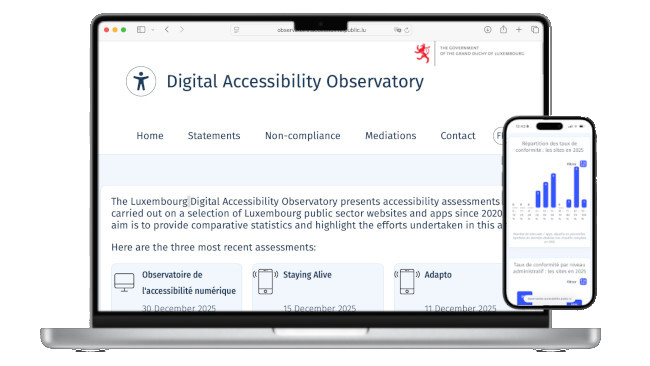
We are pleased to present the latest website designed and managed by the Information and Press Service: the Digital Accessibility Observatory, which aims to provide you with all the latest data on accessibility, updated frequently.
Friday, January 30, 2026

An annual summary of the state of digital accessibility in Luxembourg's public services is what the Digital Accessibility Portal has offered you so far. It was possible to go further and make better use of the data collected since 2021: this has now been done. As of yesterday, the Digital Accessibility Observatory is online.
Here is what it will provide you with:
- Accurate and comparative data on
- audits conducted by the Information and press service (SIP);
- accessibility statements;
- mediations conducted by SIP;
- and the most frequently identified non-compliances.
- These data will be updated frequently, and those already available provide a history covering the last five years: it is therefore easy to see how compliance has evolved, by platform or by administrative level.
Like the Digital Accessibility Portal, the Observatory is available in two languages: French and English.
An overview of the main features
Accessibility ranking
The accessibility ranking, which is the first module to appear on the home page, reflects the ongoing efforts made by the public administration to promote digital accessibility. It is easy to compare scores from one year to the next and from one platform to another.
But above all, this information is intended for people with disabilities: here, they can directly find references to websites and mobile apps that they know they will be able to access without too many problems.
Selecting a website or app takes you to a page where all the details of the audit are broken down. Better still, if this website or app has been audited elsewhere, particularly in previous years, you can access this information with a single click.
Distribution of compliance rates
This 'distribution of compliance rates' view, which uses the same data but segments it into percentiles, is undoubtedly the most suitable for tracking accessibility trends since the first audits in 2021. Here too, it is possible to display the sites listed in each column and access the assessment details.
Compliance rates by administrative level
Is there a noticeable difference between the state, municipal and public law levels? This question is answered by the module 'compliance rate by administrative level', which also offers historical research.
Accessibility statements
Essential for people with disabilities and mandatory under the law of 28 May 2019, accessibility statements are nevertheless rare: barely one in two websites has a complete and up-to-date statement, and one in ten apps (see the 'statements' page). The hope is that this legal obligation will gradually be better respected.
Non-compliance
What is wrong with the design or editorial content in the pages of a website or in the screens of a mobile app? Where are the main digital barriers? Videos, page structure, forms, images, office documents...: where should the focus be in terms of staff training? Are the same obstacles encountered year after year? This 'non-compliance' page was designed to answer these questions. Here, the criteria of the reference frameworks have all been summarised and simplified, but experts can follow a link to the relevant reference framework in each case.
Mediations
One of the key elements of an accessibility statement is a contact address for questions relating to digital accessibility. Sometimes, dialogue between citizens and the administration does not progress satisfactorily, which is why the SIP, like the Ombudsman, acts as a mediator. Consequently, the 'mediations' page shows, for each year, the number of requests submitted to the SIP and, in parallel, the number of accessible responses provided by the administration.
Accessibility
One of the main challenges in creating this observatory was its accessibility. Indeed, this website focuses heavily on data visualisations, which are relatively complex to make accessible. We had a full audit of the website carried out in accordance with RAWeb, and the website is now fully compliant.
What are the next steps?
For the time being, the audits conducted by the SIP constitute the raw material for the Observatory. However, the SIP wishes to eventually open it up to audits carried out by other public administrations in Luxembourg. This will provide an opportunity for additional, enriched and regularly updated information.
This platform is, of course, likely to evolve. If you have any feedback or requests on this subject, please do not hesitate to contact us.
This project, supported and funded by the Ministry for Digitalisation, was made possible thanks to the Tech-in-Gov programme.